
Understanding the performance of a vehicle, motorcycle, bicycle, or even an athlete goes far beyond just raw power. One of the most reliable ways to measure efficiency and acceleration potential is through the power-to-weight ratio (PWR).
This simple yet powerful metric compares the amount of power a machine or person produces to their weight, providing a clear picture of how quickly they can move or accelerate.
For car enthusiasts, cyclists, or competitive athletes, knowing this ratio can help in making informed decisions about upgrades, training, or comparisons with others.
However, manually calculating the ratio can be time-consuming and prone to errors, especially when dealing with different units like horsepower, watts, kilograms, or pounds.
That’s where a power-to-weight ratio calculator comes in. It streamlines the process, delivering accurate results instantly and allowing for quick comparisons across vehicles, bikes, and athletes.
What is Power to Weight Ratio?
The power-to-weight ratio (PWR) is a fundamental measurement that indicates how much power a vehicle, machine, or athlete produces relative to its weight. In simple terms, it is calculated by dividing the total power output by the weight, giving a figure that can be used to compare performance across different objects or individuals. The formula is straightforward:
Power-to-Weight Ratio=PowerWeight\text{Power-to-Weight Ratio} = \frac{\text{Power}}{\text{Weight}}Power-to-Weight Ratio=WeightPower
Power is usually measured in horsepower (HP) or watts (W), while weight can be in kilograms (kg) or pounds (lb). Depending on the units, the result may appear as HP/kg, W/kg, or lb/HP. For instance, a car with 300 HP weighing 1500 kg would have a power-to-weight ratio of 0.2 HP/kg, meaning each kilogram of the car’s weight is supported by 0.2 horsepower.
This ratio is highly valuable because it provides a direct insight into acceleration and overall performance. A higher ratio generally means faster acceleration and better responsiveness, while a lower ratio indicates slower performance. It is widely used in the automotive industry, motorsports, cycling, and athletics to compare performance objectively.
However, it’s important to note that while power-to-weight ratio is a powerful metric, it doesn’t capture other performance factors like handling, aerodynamics, or endurance. Nevertheless, it remains one of the most reliable and universally understood ways to measure potential speed and efficiency.
Why Use a Power to Weight Ratio Calculator?
While calculating the power-to-weight ratio manually is possible, it can be time-consuming and prone to errors—especially if you’re comparing multiple vehicles, bikes, or athletes. This is where a power-to-weight ratio calculator becomes invaluable. By simply inputting the power and weight values, these calculators instantly provide an accurate ratio, saving both time and effort.
One of the main advantages is accuracy. Manual calculations may lead to mistakes, particularly when converting units like pounds to kilograms or horsepower to watts. An online calculator eliminates this risk, ensuring consistent and reliable results. This is especially important for enthusiasts who are fine-tuning vehicles or athletes monitoring performance progress, as even small miscalculations can affect decision-making.
Another key benefit is comparative analysis. A calculator allows you to quickly compare multiple vehicles, motorcycles, or athletes side by side, making it easier to see which performs better relative to weight. For car enthusiasts, this can help identify which sports car or motorcycle offers superior acceleration. For athletes, it provides a measurable way to track improvements in strength-to-weight efficiency.
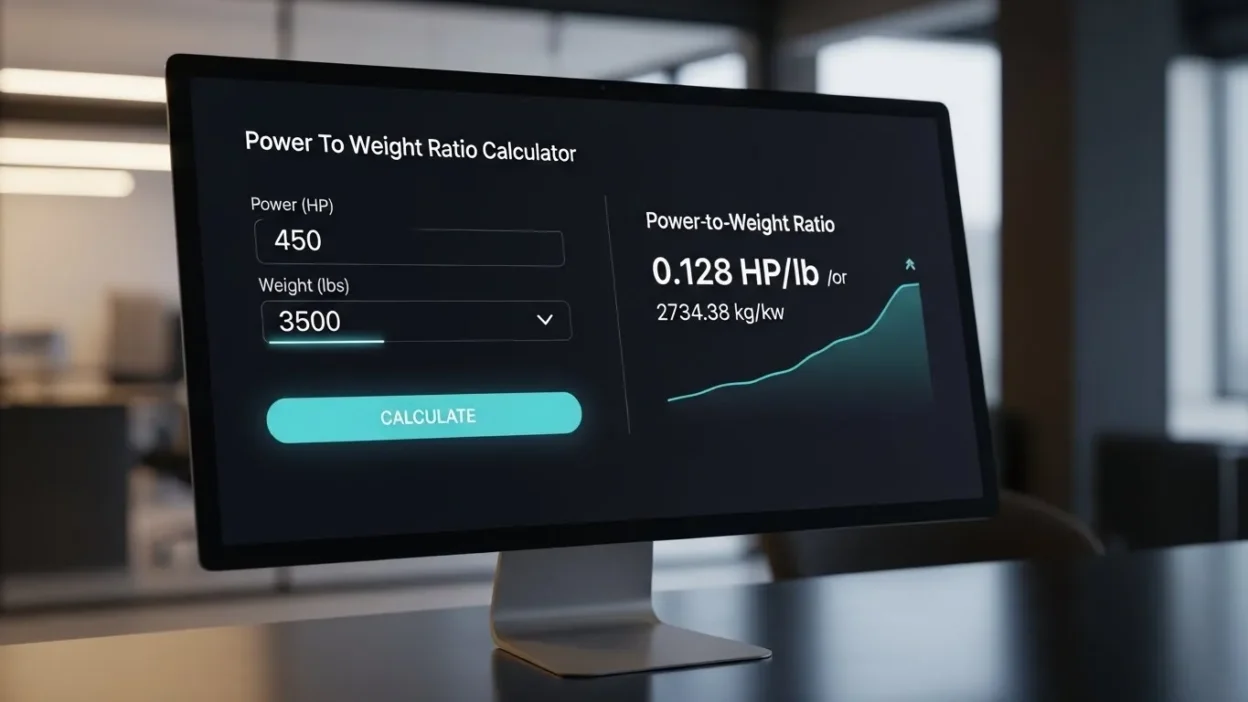
Additionally, many calculators offer flexibility with units and formats, displaying results in HP/kg, W/kg, or lb/hp, depending on your preference. Some even provide charts and visualizations, making the data easier to understand at a glance.
Ultimately, a power-to-weight ratio calculator is a simple tool with powerful insights, helping anyone make informed decisions about performance and efficiency.
How to Calculate Power to Weight Ratio Manually
While online calculators are fast and convenient, understanding how to calculate the power-to-weight ratio (PWR) manually can be valuable, especially if you want to double-check results or understand the process behind the numbers. The basic formula is simple:
Power-to-Weight Ratio=PowerWeight\text{Power-to-Weight Ratio} = \frac{\text{Power}}{\text{Weight}}Power-to-Weight Ratio=WeightPower
Step 1: Identify Power and Weight
Determine the total power output, typically measured in horsepower (HP) or watts (W). Then, find the weight of the vehicle, bike, or athlete in kilograms (kg) or pounds (lb). Be sure to include the full weight—driver, fuel, or gear—if applicable.
Step 2: Convert Units (if necessary)
If your units differ, convert them to a consistent system. For example, to convert pounds to kilograms, divide the weight by 2.205. To convert HP to watts, multiply by 745.7. Using consistent units ensures an accurate ratio.
Step 3: Divide Power by Weight
Simply divide the power by the weight. For example:
- Car: 300 HP ÷ 1500 kg = 0.2 HP/kg
- Motorcycle: 100 HP ÷ 200 kg = 0.5 HP/kg
Step 4: Interpret the Result
A higher value indicates better acceleration and performance, while a lower value suggests slower responsiveness.
By manually calculating the ratio, you gain a clear understanding of the relationship between power and weight. This knowledge is essential when comparing vehicles, motorcycles, or athletes and allows you to make informed decisions about upgrades, training, or modifications
Using an Online Power to Weight Ratio Calculator
An online power-to-weight ratio calculator makes determining this critical performance metric faster, simpler, and more accurate than manual calculations. Instead of spending time converting units or performing multiple steps, you can obtain results instantly by entering the required data.
How it works: Most calculators only need two inputs: the total power (in HP or watts) and the weight (in kg or lbs). Once you input these values, the calculator automatically computes the ratio and often provides the result in multiple units, such as HP/kg, W/kg, or lb/HP. Some advanced calculators also allow you to add driver weight, fuel load, or gear for a more precise measurement.
Advantages of using a calculator:
- Accuracy: Eliminates errors from manual calculations or unit conversions.
- Speed: Provides immediate results, ideal for comparing multiple vehicles or athletes.
- Visualization: Many calculators display results with charts or comparison tables, making it easier to interpret the data.
- Accessibility: Available on desktops, tablets, and smartphones, enabling you to calculate ratios anytime, anywhere.
Practical examples: Car enthusiasts can compare different sports cars before making purchasing or tuning decisions. Motorcyclists can evaluate performance improvements after modifications. Athletes can track progress in strength-to-weight efficiency over time.
Overall, an online calculator is a powerful tool for anyone who wants reliable, instant insights into performance, making it an essential companion for enthusiasts, professionals, and competitive athletes alike.
Interpreting Your Power to Weight Ratio
Calculating the power-to-weight ratio (PWR) is only the first step; understanding what the number actually means is just as important. This ratio provides a clear indicator of how efficiently a vehicle, motorcycle, or athlete can convert power into movement.
A higher ratio generally indicates better performance. For vehicles, this translates to faster acceleration and improved responsiveness. For example, a sports car with a ratio of 0.3 HP/kg will accelerate faster than a sedan with a ratio of 0.15 HP/kg, assuming other factors like aerodynamics are similar. For athletes, a higher W/kg ratio means more efficient power relative to body weight, which is critical for cycling, sprinting, or other performance-driven activities.
On the other hand, a lower ratio suggests slower acceleration or less efficient power output. However, it’s important to remember that the PWR is not the sole measure of performance. Factors like torque, aerodynamics, handling, endurance, and terrain also play significant roles, particularly for vehicles. For athletes, technique, stamina, and training consistency matter as much as raw power relative to weight.
Comparisons are most meaningful when ratios are calculated consistently, using the same units and including all relevant weight, such as driver, fuel, or gear. For example, comparing two cars with vastly different weights without accounting for occupants or modifications can give misleading results.
By understanding the PWR and its context, you can make informed decisions about upgrades, training, or vehicle selection, ensuring that the ratio reflects true performance potential rather than just numbers on paper.
Tips to Improve Your Power to Weight Ratio
Improving your power-to-weight ratio (PWR) can significantly enhance performance, whether you’re upgrading a vehicle, motorcycle, bicycle, or focusing on athletic training. Since the ratio depends on both power and weight, there are two main strategies: increase power or reduce weight.
1. Reduce Weight: One of the most effective ways to improve PWR is by decreasing the total weight. For vehicles, this can include removing unnecessary parts, using lighter materials like carbon fiber or aluminum, or opting for smaller wheels and tires. Even minor reductions, such as shedding excess cargo, can make a noticeable difference. For athletes, reducing body fat while maintaining muscle mass improves the power-to-weight balance, enhancing speed and efficiency.
2. Increase Power: Boosting the power output is the other approach. For vehicles, this might involve engine tuning, performance upgrades, or forced induction systems like turbochargers. Motorcyclists can enhance power with aftermarket exhausts or ECU remapping. Athletes can improve power through strength training, sprint drills, or high-intensity workouts to generate more force relative to their body weight.
3. Balanced Approach: While it’s tempting to focus solely on power or weight, a combination of both yields the best results. Over-reducing weight can compromise safety or stability in vehicles, while overemphasizing power without control can reduce efficiency. Similarly, athletes must balance weight loss with strength maintenance to prevent injuries.
4. Track Progress: Using a power-to-weight ratio calculator regularly helps measure improvements, track modifications, and optimize performance over time.
By strategically managing both power and weight, you can maximize acceleration, responsiveness, and overall efficiency, whether on the track, the road, or in sports performance.
Applications Across Vehicles and Sports
The power-to-weight ratio (PWR) is a versatile metric used across multiple fields, from automotive performance to athletic achievement. Understanding its applications helps you see why this simple calculation is so valuable.
1. Cars: PWR is a crucial metric in the automotive world, especially for sports cars and high-performance vehicles. A higher ratio means faster acceleration and better handling in track or street conditions. For example, two cars with the same horsepower can perform very differently if one is significantly lighter. Vehicle enthusiasts use the ratio to compare cars, evaluate upgrades, and make purchasing decisions.
2. Motorcycles: Motorcycles, being much lighter than cars, often have higher PWR values. Riders and racers rely on this metric to gauge acceleration potential, track performance, and make modifications. Lightweight bikes with strong engines deliver superior responsiveness, making PWR a key factor in competitive racing.
3. Cycling and Athletics: For athletes, particularly cyclists, runners, and rowers, the ratio of power output to body weight (W/kg) is critical. Sprinters need a high PWR for explosive speed, while endurance athletes focus on maintaining an efficient ratio over long distances. Coaches use the ratio to monitor training progress, optimize body composition, and improve performance.
4. Other Applications: PWR is also useful in robotics, drones, and remote-controlled vehicles, where efficient power-to-weight management directly affects speed, maneuverability, and battery life.
By understanding and applying the power-to-weight ratio in these contexts, enthusiasts and professionals alike can make informed decisions, whether it’s improving vehicle performance, selecting the right bike, or optimizing athletic training
Common Mistakes to Avoid
While the power-to-weight ratio (PWR) is a straightforward metric, many people make common mistakes that can lead to misleading results or incorrect performance assessments. Being aware of these pitfalls ensures your calculations remain accurate and meaningful.
1. Forgetting Full Weight: One of the most frequent errors is neglecting to include all relevant weight. For vehicles, this includes the driver, passengers, fuel, and gear. For athletes, it means considering body weight accurately. Ignoring these factors can make the ratio appear artificially high, giving a false sense of performance.
2. Confusing Units: Power and weight come in multiple units, such as horsepower (HP), kilowatts (kW), pounds (lb), and kilograms (kg). Mixing these units or failing to convert them correctly can lead to incorrect calculations. Always ensure consistency before dividing power by weight.
3. Relying Solely on PWR: While the ratio is valuable, it doesn’t account for other performance factors like torque, handling, aerodynamics, terrain, or endurance. For vehicles, acceleration may be excellent, but cornering or stability might be poor. For athletes, strength-to-weight is critical, but technique and endurance also play key roles.
4. Ignoring Modifications: Changes in power output or weight, such as vehicle upgrades or body composition changes in athletes, must be updated in calculations. Using outdated values can misrepresent performance.
5. Comparing Inconsistent Metrics: Comparing vehicles or athletes without consistent conditions or units can be misleading. Always use the same type of measurement, including gear, fuel, or training level.
By avoiding these mistakes, you ensure that your power-to-weight ratio remains a reliable, accurate tool for measuring performance and making informed decisions.
FAQs
1. How do I calculate power-to-weight ratio for multiple vehicles or athletes?
To compare multiple subjects, calculate each individual’s ratio using consistent units. For vehicles, include driver and fuel weight; for athletes, ensure body weight is current. Using a calculator simplifies comparing multiple results quickly.
2. Is a higher power-to-weight ratio always better?
Generally, a higher ratio indicates faster acceleration and more efficient performance. However, it isn’t the only factor. Vehicles with excellent PWR may have poor handling, while athletes may lack endurance or technique despite a strong ratio. Balance and context matter.
3. Can I compare different types of vehicles using the same ratio?
Yes, but with caution. Comparing cars to motorcycles or trucks to sports cars is possible numerically, but differences in design, handling, and traction can affect real-world performance. Use PWR as a general indicator rather than a definitive comparison.
4. Do calculators account for weight distribution?
Most standard calculators only consider total power and total weight. They do not factor in weight distribution, aerodynamics, or traction. For more detailed analysis, specialized software or testing equipment is needed.
5. How often should I recalculate power-to-weight ratio?
Recalculate whenever there is a significant change in power or weight. For vehicles, this could be after modifications, adding passengers, or fuel load changes. For athletes, recalculate as body composition or training levels change. Regular monitoring helps track improvements accurately.
By addressing these common questions, you can better understand and apply the power-to-weight ratio, making it a practical tool for performance analysis in vehicles, motorcycles, and sports.
Conclusion
The power-to-weight ratio (PWR) is a simple yet powerful metric that provides valuable insights into performance, whether you are evaluating vehicles, motorcycles, bicycles, or athletes.
By measuring the relationship between power and weight, it allows for an objective comparison of acceleration, responsiveness, and overall efficiency.
Understanding this ratio is especially useful for enthusiasts and professionals who want to make informed decisions about upgrades, training, or modifications.
Using a power-to-weight ratio calculator streamlines this process, eliminating errors from manual calculations and unit conversions. It enables quick comparisons between different vehicles or athletes and provides instant results in multiple units, such as HP/kg, W/kg, or lb/HP.
With the ability to track changes over time, the calculator also becomes a tool for monitoring progress, whether it’s after vehicle modifications or improvements in athletic performance.
However, it’s important to remember that while PWR is highly informative, it is not the sole determinant of performance. Factors like handling, aerodynamics, terrain, technique, and endurance also play critical roles in real-world scenarios. Additionally, accuracy depends on including all relevant weight, such as drivers, fuel, gear, or body mass.
By combining proper calculation, interpretation, and practical application, you can leverage the power-to-weight ratio to enhance performance, make smarter choices, and gain a deeper understanding of efficiency.
If you are a car enthusiast, motorcycle rider, or athlete, using this metric wisely allows you to unlock the full potential of your machine or body.